




|
COME and LISTEN
by appointment at DECWARE  OR join our
forums and
ask who's in your area with Decware gear. |
|
|

|
IF YOU COULD
SEE SOUND... OUR AMPS WOULD SOUND LIKE THIS:
|

|
IF THE FIRST WATT
SUCKS...
WHY CONTINUE?:
|

|
WHY THE SET
& EFFICIENT SPEAKER APPROACH
WORKS!
 An article that explains where we're coming from. CLICK HERE |
|
|


|
READ the
REVIEWS of these fine amplifiers  |

Subscribe

Choosing
which
Decware
amplifier
is easy!
|
We do things a little different here at Decware... We elected not to do a "Good, Better, Best" approach with our amplifiers. Instead they are all nearly equal in fidelity, just different in power and features. This means our least expensive 2 watt amplifier can impress with the same holographic grain free imaging as our most expensive 60 watt amplifiers at 10 times the price! All you have to do is simply choose the power and features that fit your speakers the best! Remember, Our 2 watt amplifier paired with a 94 dB speaker will achieve the same loudness, bass and dynamics as an 83 dB speaker will with 32 watts. Using the same comparison, the 94 dB speaker will be almost 400% faster making things like resolution, linearity and transient response far more appealing than the 83 dB speaker. To understand this a bit better you can read the article "Why the SET & Efficient Speaker Approach Works" shown below.  Steve Deckert, designer of Decware amplifiers.
The biggest factor in choosing the best Decware amplifier is your speakers! If your speakers are less than 94dB, then refer to the chart below: How loud is loud?
 A nice pairing is a
speaker/amp combination that will play at level red
or higher. A nice pairing is a
speaker/amp combination that will play at level red
or higher.
Common stumbling points: Integrated vs. Regular Amplifiers The classic definition of an integrated amplifier is one that does not require a preamp, has the ability to select from different inputs and of course features a volume control. To many this means that an integrated is the combination of a pre-amp and power amp in the same chassis! Decware amplifiers are all actually straight power amps, in so much as they do not contain a preamplifier in the classic sense. What we do is install a passive volume control on the input of the amplifiers so that should a person want to, he or she can hook a CD player or DAC or similar line level source directly to the amplifier and use it without a separate preamp. This has many advantages which go far beyond the obvious. Also, on most of our amplifiers we offer more than one set of inputs and a switch to select between them. Again, this makes using the amplifier without a separate preamp even easier. In our opinion, every power amp in the world should be made this way but they're usually not because the manufacturers want to sell you a preamp. With Decware amplifiers, preamps are always optional. Rather than sell preamps as a necessity to make your amplifier work... we sell preamps to improve the sound quality and dynamics of your source components. Mini Torii vs. SE34I.4 Both of these amplifiers a similarly priced and close in power so it should help to know the following: The SE34I.4 is a single ended triode (SET) amplifier, designed just like our 2 watt amplifier. It can be configured with up to 4 pair of inputs for a stealthy system with minimal cables and components. This amp is simple to use, has very few tubes, and features nice meters. The Mini Torii is a single ended pentode (SEP) amplifier that was designed to be the worlds most exotic desktop amplifier. It's small size and extra gain make it ideal for desktop applications. Because it has more gain than our other amplifiers, it can be driven by something as weak as an iPod or smartphone and come of with surprising dynamics. This amp is also very at home in the listening room, but is more complicated due to the larger number of tubes, and does not feature nice meters. Torii MK4 vs. ZMA (Zen Mystery Amp) Other than power, both amplifiers are similar. If either would work with your speakers and the difference in power is not a factor, you're going to be wondering what the differences are and which one to choose. The differences are fundamental. The MK4 uses tube regulation to achieve linear response without negative feedback. The ZMA is an ultra linear design that does not require it. Between the two they are even in sound stage and imaging. The MK4 was designed so that it's output current follows impedance creating a condition where lean sounding single driver speakers as well as horn speakers will have some added weight and better bass. The ZMA does just the opposite and tries to ignore the impedance of the speaker giving it more honest and more predictable results across a wider range of speakers. If you have doubts about which one would sound best with your speakers you can e-mail Steve Deckert directly for a quick response. Zen @ Decware.com or call us at (309) 822 5255. So let's assume that despite the differences listed above, your speakers would still be great candidates for either amp... what else is there? In a word, meters. The ZMA has meters for each output tube (4 total) that let you see at a glance exactly what condition your tubes are in. Meters tell you if your tubes match, let you watch the tubes age, show you weeks in advance when or if a tube is likely to fail, and meters show you how the tube responds at full power by dancing in real time to the music when you are almost out of power. The ZMA biasing system makes it a two second job to adjust your tubes without tools, in fact it is so easy you can do it on the fly at any time while listening to music. You can use the meters to change the bias of the tubes which in turn change how the tube sounds. It also makes it compatible with a wider variety of substitutions should you wish to explore the sounds of different output tubes. This feature alone is worth the difference in price between the two amps, especially if you run expensive or exotic new old stock tubes in your amps. More about the differences between the two amps can be found at post #147 in the Mystery Amp forum. Hazen Grid Mod The Hazen Grid Mod is a slick little trick that connects the suppressor grid to the cathode through a capacitor which stores and then releases electrons that bounce off the plate of the tube. The result is better transparency when true pentodes are used. The only two popular true pentodes in the audio area are the famous EL34/6CA7 and the EL84/6BQ5. The Hazen Grid Mod ( aka Christmas Comes Early -CCE mod ) is standard on all Decware amplifiers except the Mini Torii which uses different output tubes. It's worthy to note that amplifiers like the TORII MK4 and the ZEN MYSTERY AMP can use both EL34 and KT66 output tubes. KT66 output tubes do not take advantage of the Hazen Grid Mod, but the tube has other strengths that we feel offset this fact. If you are thinking about getting the MK4 or the ZMA you can have the piece of mind in knowing that either tube compliment sound absolutely great! Preamps Preamps are a much easier choice. First off, every amp above will work perfectly well WITHOUT a preamp. They also work perfectly well WITH a preamp. A good preamp can make digital sound a bit more analog and increase the weight and dynamics of your source. So if you decide to have a preamp, we only really have two... 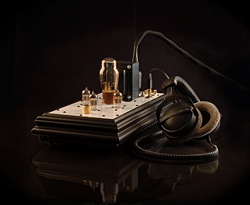 model CSP2+ This Preamp works with ALL amplifiers, tube or solid state - has a switch for 2 sources. Also comes standard with a headphone jack. 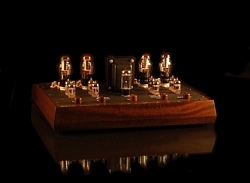 model ULTRA The Zen Ultra is a 6 channel preamp designed for tri-amped stereo playback or 5.1 home theater - has a switch for 4 sources + 4 additional direct sources. If you need more sources we also sell a switch box that will let you have up to 4 additional sources. ZSTAGE - Gain Stage designed to add dynamics to music when a preamp is not used. Ideal for low power tube gear. ZBOX - Buffer Stage designed to warm and add dimensionality to solid state gear but can also be used with higher power tube amplifiers when the same results are desired. |
||||||||||||||||||||||||||||||||||||||||||||||||||||||||||||||||||||||||||||||||||||||||


