Title: Re: ZSTYX shielding
Post by will on 09/10/26 at 21:36:06
I used Styx for some years early in my Decware journey... maybe around 2009? I liked them better than the DIY ethernet cable wire formula I used that was popular at the time, inexpensive, but a lot of work to make. They were decent, but I liked how the Styx blended silver qualities with copper fairly transparently, creating a more complex, immediate, dynamic, and big sound.
But finally, after some years of experimenting with them, especially since I need pretty captivating balanced and complete sound across most of the recordings I have, the sound was just too big and forceful for me. Quite beautiful on many recordings, but on others, just too much signal intensity, concentration and density making the bass/mid-bass/low-mids lean into full and slowish on recordings leaning that way, and the mids and upper-mids, also strong, tending a little to close to the edge of bouncing into sharp, hard and rigid on peaks, again, especially with some recordings. I used them for a long time though, liking a lot about them, but always working on relaxing them, I realized they were just overstated for me. Still I liked a lot about them and I enjoying them overall.
And really, it is all so system/room dependent along with varying goals/tastes.... My needing, across the spectrum, very refined speeds, fine resolution, space and complexity, all within the fine lines of musical spectral balances.... while being just focussed and dense enough to sound real, and not throw off these complex balances @#$%^&* challenging! So far for me, this takes a particular average where all musical balances support one another, sounding like well recorded music in a good room, and that feeling conveying to my room. Then, with various recording styles, I need good gain riding tools that can adjust the signal intensity one way or the other "off" this carefully found "average," to optimize varying recordings. For these goals, in my settings, the Styx were not an ultimate reference.
Relative to EMF/RFI, and your cables JHC, I found the following from Brave Browser's AI search summarizer, which can sometimes feel overly general, and sometimes lacking in nuance, but I find surprisingly useful a lot of times, and it shows links it references, allowing cross checking and deeper searching. A long time ago now, after lots of experiments making cables with nice materials, finding the right gauges and blends, solder, etc, I found using relatively subtle and particular "twisting" and crossing wires could help me find the fast, resolved, and musical balances I needed. Along with these, though I did not know the term, I have been using "cross linking" for a long time too, helping me discover my favorite home-made cables. A big part of what makes all this work together, as far as I can tell, is a lack of noise and smearing, which also results from making them quiet. For this, geometry became as important as quality ends, wires and particular wire gauges and blends.
So I copied this from your cable design writeup for a search: "Geometry - Internal Twisted, Cross Linked speaker cable" adding "effect" at the end:
"Internal twisted and cross-linked geometries in speaker cables primarily reduce inductance and cancel electromagnetic interference to improve signal integrity. The twisted pair configuration forces the positive and negative conductors to spend equal time near external noise sources, creating a common-mode signal that amplifiers cancel, often shaving 15–20 dB off 60 Hz hum. Additionally, twisting the conductors lowers loop inductance while slightly increasing capacitance, which helps maintain a steady impedance (within ±0.2 Ω) and preserves bass punch and transient response.
Cross-linking or cross-field layer geometries (such as those used in Townshend Audio or Cardas cables) arrange conductors to minimize magnetic field interaction and dielectric absorption. This geometry is designed to match the characteristic impedance of the cable to the speaker load, reducing micro-reflections that can cause brightness or hardness in the sound. By using separate tubes or air dielectrics for twisted pairs, these designs further lower the effective dielectric constant, resulting in lower dissipation factors and more transparent, detailed sound reproduction with better spatial cues.
Inductance Reduction: Twisting conductors allows their magnetic fields to oppose each other, reducing self-inductance below that of straight parallel wires.
EMI/RFI Rejection: The geometry ensures equal exposure to external electromagnetic fields, allowing the receiver to subtract induced noise.
Impedance Matching: Cross-linked designs aim to align cable impedance with speaker impedance, minimizing signal reflections and transient smearing.
Dielectric Improvement: Using air or specific insulators between twisted pairs reduces energy loss and distortion.
Crosstalk Reduction: Twisted pairs keep crosstalk low (under 0.5%) when multiple cables are bundled, ensuring channel separation."
Can't say these points are absolute, not being expert, or a measurer except from listening. But this summary seems to point to pretty tried and true concepts for many, while implying your cables have already incorporated good ideas for a clean/unsmeared signal.
Also, like CAJames' solution suggests using styx, if it is an antennae affect, shortening the antennae makes sense.
Also, seems some consensus, as you suggest, that with extreme magnetic field interference, shielding can help.
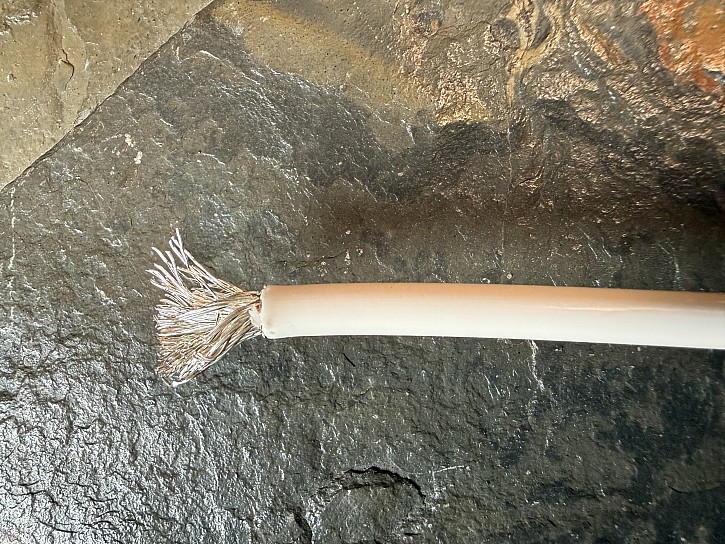
I avoid traditional shielding myself if I can, finding it can reduce very fine information, sounding like a subtle smear when I have heard it. I am guessing it is from the interaction between the shield and signal wires, and a result is a reduction of very fine information, something I depend on. This surmise came from my experience when I started weaving wires around cotton rope for interconnects to avoid interaction, where I thought separating and crossing the wires just so left the signal more complex in resolution and speed and space, more "pure." So when it looked like I needed shielding on some of my Torii internal cables, I covered the geometry I had liked with oversized pure copper shield cable, separating it from the signal wires more than the usual. This resulted in what seemed to me a quieter, yet still nicely resolved and fast sound.
Finally, it all is so variable, and everything effects everything, so I hesitate to comment on these questions... just too many "truths" out there that are based on, to me, often too narrow a context to be as absolute as the person suggests a lot of the times. But when I have some experience from my own experimenting that seems to corroborate some of the consensus, I guess I feel OK about telling my tale...
I wonder, if after testing tubes and adjusting your cables to be more sure they are not interacting (like ICs crossing power cables rather than parallel), and the like... if still an issues, as a relatively low cost speaker cable shielding test, I wonder about wrapping some aluminum foil around your speaker cables with the spiral edges overlapping, and leaving enough foil at the amp end to fold into a "connector" that could be connected to the chassis of your amp for ground (assuming the chassis is grounded?)...this might the tale?
|
 Good luck