|
Forums
https://www.decware.com/cgi-bin/yabb22/YaBB.pl AUDIO FORUMS >> Replacement Tubes >> Tube Information https://www.decware.com/cgi-bin/yabb22/YaBB.pl?num=1787922782 Message started by Lon on 08/28/26 at 14:13:02 |
|
Title: Tube Information Post by Lon on 08/28/26 at 14:13:02 Found this on facebook, there are probably other factual (?) pieces that can be shared among us. ![]() The GETTER SHAPES and Manufacturers listed below reflect general production tendencies, not strict rules. Tube factories frequently changed internal designs over the years, so the same manufacturer may use different getter types across different periods. ========================================== Top Hat / Cup Getter One of the earliest getter designs, common in 1940s to early-1950s tubes. Often used in early American production from RCA, GE, and -Tung-Sol. This style getters reflect early post-war tubes. D Getter Very common in 1950s to early-1960s production. Frequently found in tubes made by Mullard (Blackburn), Philips / Amperex, and RCA. The D-shaped getter is a classic vintage tube construction. Square Getter Less common, seen mainly in 1950s–1960s European tubes. Often associated with Valvo (Hamburg) and Telefunken, as well as the American Raytheon. Round Getter (angled ring) Widely used during the late-1950s through the 1960s. Common in tubes from RCA, Sylvania, and Mullard. The ring is usually angled and supported by a single rod. Halo Getter (horizontal ring) More typical of mid-1960s onward production. Often seen in tubes from Philips / Amperex, Matsushita, and Toshiba. The ring sits horizontally like a halo above the structure. |
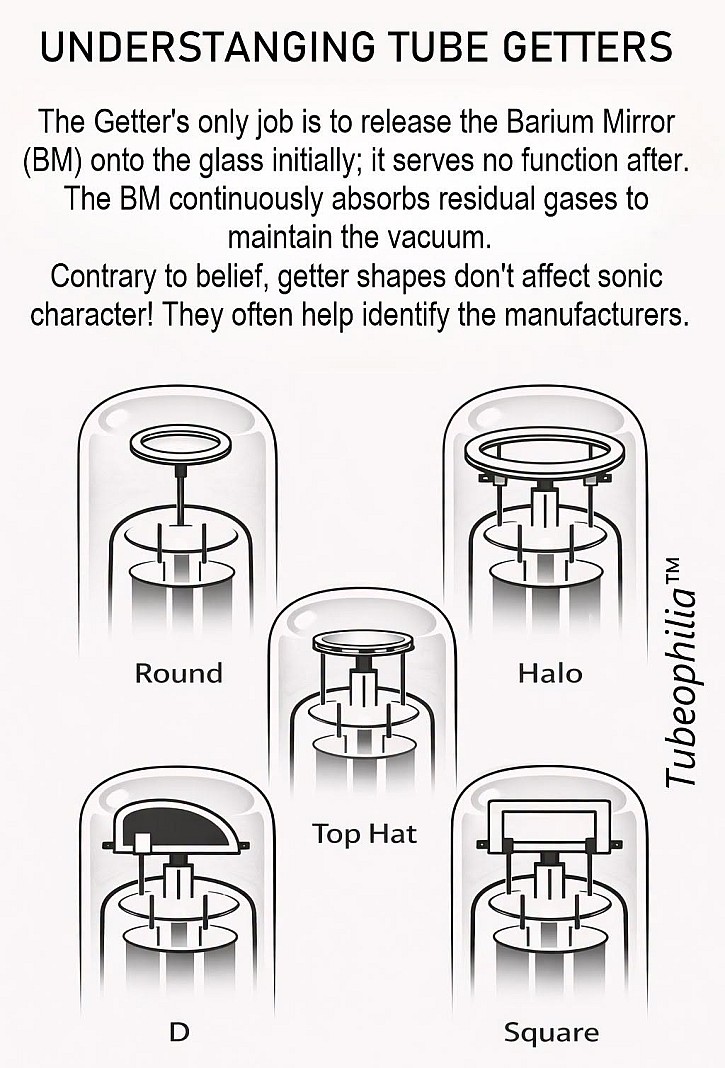
|
Title: Re: Tube Information Post by CAJames on 08/28/26 at 19:40:14 IMO whether or not the getter actually "affects sonic character" is A) hard to know and B) not the point. What they do do is help identify not only the manufacturer but also the manufacturing era. And those factors usually affect sonic character. |
|
Title: Re: Tube Information Post by Lon on 08/28/26 at 19:49:47 Agreed. I'm unconvinced the construction of the getter has no sonic effect, but it does point one in a direction of manufacturer, date etc. which do have sonic impacts. |
|
Title: Re: Tube Information Post by Donnie on 08/28/26 at 20:19:58 I watched this video about comparing a Mac amp to a Chinese clone amp and he gets into measuring outputs with different tubes and it gets pretty interesting. https://www.youtube.com/watch?v=qQV7Oan3I68&t=1344s The differences are subtle between the amps and the different tubes but I think this is what we hear. I do wonder if the other sonic differences can show up in measurements, you know, the stuff that we listen for like width and depth. |
|
Title: Re: Tube Information Post by CAJames on 08/29/26 at 16:18:43 Quote:
Yes, well presented but it is pretty much the same thing John Atkinson (a recovering electrical engineer) was saying in Stereophile 40 years ago. Quote:
I'm going to say no, for a couple reasons. First is specially width and depth depend on both your room and your speakers, so just measuring the amp would give you an incomplete picture, at best. But the other thing is people have been measuring amps, and on the flip side, recordings, for a long time looking for "measurements that matter" and AFAIK haven't learned anything new since the 60s. Signal to noise, channel separation, distortion, square wave response, there may be a few others I'm missing but there really isn't anything new under the sun. Another way to look at this is what do musicians do? These days they use an app to tune up, but everything else they do by ear. I used to play some back in the day, and no one ever considered using measurements, or "double blind testing" when they were working on the their sound. They did what sounded good to them. And I think that is still the model for what amp designers do: measurements can find obvious problems, but the details are done by ear. |
|
Forums » Powered by YaBB 2.2.2! YaBB © 2000-2008. All Rights Reserved. |