|
OFFICIAL WEB SITE
Size 13.5" x13.5" x 19"

2 BOXES CAN BE BUILT FROM
1 SHEET
HOW
TO BUILD ONE YOURSELF
SKILL
LEVEL: This is an easy
box to build provided you have
a good table saw and can make
accurate cuts.
TOOLS
NEEDED: Besides a
table saw (with sharp blade)
you will need clamps,
carpenter's wood glue, a
sander (belt sanders work
well) and a drill.
WOOD
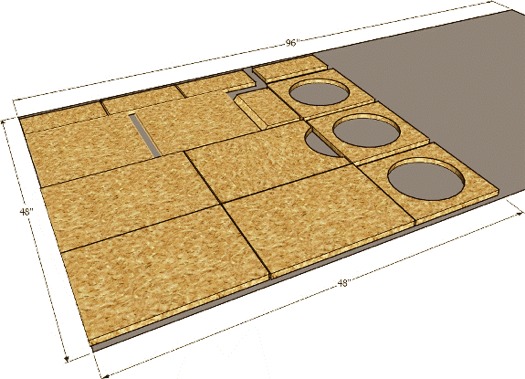
NEEDED: The box can
be built from exactly 1/2
sheet of 48 x 96 inch plywood,
MDF or high density particle
board. Below the add to cart
button is a cut-sheet
illustration showing how each
panel should be laid out for
cutting:
TIP
The trick to assembly is to
construct the insert
first. Then wrap the
side panels around the insert
and install the bottom
panel. This way the
insert will move inside the
box with a perfect fit.
SCREWS
are typically only used to
fasten the removable top (lid)
so that the woofer can be
accessed. If you
properly build the box with
wood glue and clamps, nails
are not needed as the glue
becomes stronger then the wood
itself. If you have an
air nailer, you can use 2 inch
finish nails to hold the
panels together in place of
clamps while the glue dries.
FINISHES: The
most common way to finish this
cabinet is to paint it.
There are tons of finishes
available that can make the
box look like anything from
rock, to marble. Also
you can use real wood veneer
for a completely professional
look in the house.
WOOFERS: Decware
makes an ideal and well loved
woofer for this cabinet.
However, the very design makes
it compatible with 100's of
different 10 inch car audio
woofers that work in smaller
boxes. Even an
inexpensive woofer will see
double it's rated power
handling in this enclosure and
sound great doing it.
JOINERY: The
quality of your cuts
determines the joinery or fit
of each panel. Quality
joinery is a major part of the
distortion free performance of
this box. If you're into
box carpet and liquid nails to
hide your joinery, and demand
the best performance consider
purchasing one already built
by Decware. We use CNC
machines and build the
cabinets more perfectly then
is possible to do by hand.
WIRING:
Since this box can be pointing
in any direction other then
face down, no official back or
front have been defined.
We recommend soldering a pair
of stranded 16 AWG copper
wires to the woofer terminals
and run the wire out through
the port opening. Make it long
enough to connect directly to
your amp. If you decide
to hide the wire, you can
drill a small hole through one
of the sides of the box and
seal the wire with caulk where
it passes through the
hole. Terminal cups leak
air and are not recommended.
|
Model DMK10-II
DEATHBOX
Featuring the
Transmotional Insert
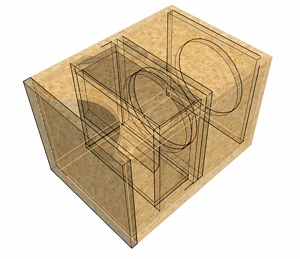
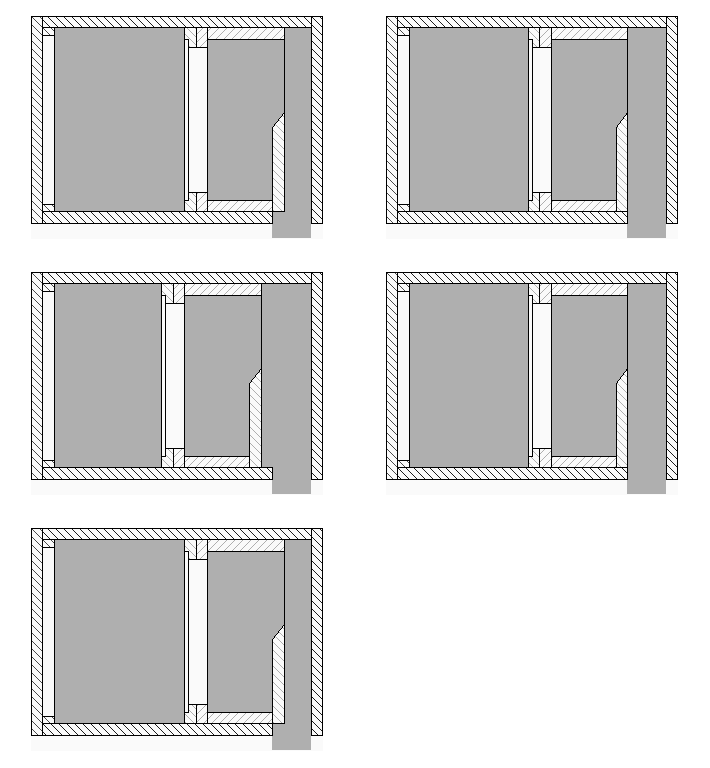 In this animated illustration, you
can see the adjustable insert in three
possible positions.
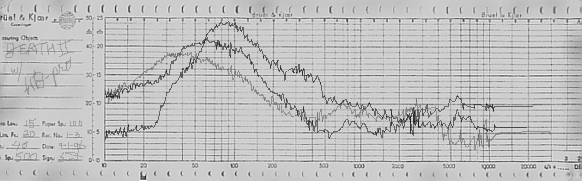
FREQUENCY RESPONSE OF
DIFFERENT POSITIONS
This is the actual response
test done on each of the three positions
above.
In this animated illustration, you
can see the adjustable insert in three
possible positions.
FREQUENCY RESPONSE OF
DIFFERENT POSITIONS
This is the actual response
test done on each of the three positions
above.
|
A STUDY IN POWER HANDLING
Explains why this
is the best 10 inch sub box
design ever!
The Death Box was originally a
study in power handling. We
studied why woofers blow up,
especially in band pass boxes and
in the process optimized a design
to minimize the negative effects
of abuse.
I guess you can tell we were in
the car audio business! This
process of seeing how far we could
take a 10 inch woofer and what the
causes of failure were, is how the
box got it's name.
We built and tested over 95
revisions of the classic band pass
box to improve power handling and
SPL. This lead to
eliminating the typical port and
replacing it with a symmetrically
perfect duct system that kept
internal pressure evenly
distributed on the woofer cone.
We also found cabinet resonance
would excite the woofer in
negative ways and reducing it
improved performance.
Adding a restriction to the duct
assembly outlet created a duct
that would now resonate across a
wider frequency band (like a
vero-vent) and that improved power
handling again.
Creating a fixed symmetrical duct
/ baffle assembly that was
transmotional allowed the circuit
to be optimized for different
woofers and tuned in its final
destination, the room or car.
The resulting transmotional duct
system yields symmetrically even
pressures on the speaker cone,
hence we named it SCD (Symmetric
Compensation Design).
A secret to successful car audio
systems is of course your
subwoofer, or foundation.
Understanding that a car is not a
living room, but rather a box is
the first step to understanding
cabin gain. When you put a box in
a car, you are actually putting a
box inside a bigger box, thus
creating additional orders.
Because of this reactive
capacitance all around your box,
having two 12" woofers openly
firing into the car is usually
asking for all kinds of
performance variables. This is the
reason why one enclosure will
sound good in one car, and
terrible in another.
We have determined that to
minimize these loading problems,
and to allow an enclosure to
breath freely, it must be
consistent with a small box to
room ratio of less than 15%. It is
also desirable to control the air
space in front of the woofer by
removing the capacitance created
by flexing metal in your trunk.
This is why we chose a band pass
design to begin with.
There are currently copies of this
box being marketed that do not
employ SCD technology, are not
transmotional, and are not able to
be tuned to your choice of
subwoofer and car. Needless to say
the results are inferior. DECWARE
makes the only original Death Box.
Deathbox
White Papers
|
COMMENTS from Users:
|
"This is
for Steve, I called you last
week about the Death box. I
ended up adjusting the
insert at 2 inches
from the end. Stuffed the
back with polyfill, and
screwed it to the floor of
my trunk.
!!!WOW!!!
I
have the 2 JL10W6's running
Isobarically with around 300
watts rms to each one. Yikes.
I can really make the earth
move now. When I turn it up I
wonder why I bought Bass
Shakers. I was testing it out
for polarity and wiring and I
blew the back end of the box
off. All the screws weren't
in. It almost has more bass
than I need. My 5-1/4 comp.
set cant balance it that well.
no problem though."
- Troy from North
Dakota
|
|
"Steve,
There is only one word
to describe that box
"Awwwwwesome"! It didn't
seem to play as loud as my
bass reflex box but when we
cranked it up I was amazed
in how clear it played. You
could hear definition in the
bass tracks that just
weren't there before. I
could boost the bass as much
as I liked with no sign of
distortion.
The one
major problem with your
Death Box design is once I
compared it to my bass
reflex I can't stand my old
box anymore. It really
sounds mushy and distorted
in comparison to the Death
Box. Any way I just though
I'd let you know that we got
the box built and
installed in the old Honda
and we love it. My son is
getting all kinds of
compliments on the sound. I
appreciate all your help in
this project and hope to try
some more of your good
stuff. Thanks Much!"
-Larry Daube
|
|
"Steve..
Well, I built the Deathbox
for a friend for his home
theater, and he LOVED it!.
It was built with a 10" DVC
Radio Shack Subwoofer ( my
friend is a little cheap)
with an advertised QTS of
.52 and it still gave great
performance (of course, I've
never heard it loaded with a
driver with the proper T/S
parameters). . Thanks for
the great design!
Thnx, "
-Nik
Martin
|
"Dear
Steve, Your Deathbox is slowly
starting to p*ss me off. I had
a box with 2x 12" 's in the
trunk of my VW 16V Gti Golf
and two 8" mid's on the
package tray. Worked
fine, except; no bass.
So I built the deathbox (10"
version). Got a brand
new woofer; new wires and
everything I needed. I
looked at the wood and the
woofer for a long time; to
intimidate them, like you
suggested. Then I
started...
There's so much bass in the
car now, that I had to install
mid's in the front kick-panels
(which I did a very nice job
of, if I say so myself), and
some tweeters in the dash, and
of course everything is wired
up with your phase delay
wiring scheme.
So now I can make my
nose-hairs itch with bass, and
I've got the most incredible
sound in the area.
So I just wanted to let you
know, apart from the fact that
I'm slightly broke at the
moment, if you don't hear from
me again, it's most probably
because my girlfriend killed
me "because I love my car more
than her..."
Thanx for a great Web site and
THE best designs I've ever
come across.
P.S. I'll let you know
how my Housewrecker turned
out."
-Piet Steyn
Dept. Engineering
Potch University
South Africa
|
"Steve..
thank you greatly for the
plans.. I have never
heard a 10 inch woofer
'boom' as loud as now. It
actually shakes the
front 2 seats! I do believe i
can gain more however because
i am only using a 200w amp.
Finally, I would once again
like to congratulate, you and
your company.
From another extremely pleased
customer."
-Ryan.
|
"Dear
Mr. Deckert,
Your web page is absolutely
fantastic. I read about it
in the newsgroup
rec.audio.car, and decided to
give it a read. I was
amazed by the fact that
someone has put together
the facts and great
examples that everyone who
ever wanted to upgrade
their stereo system needs to
read. I will recommend your
web page to all of my friends
interested in car audio
(almost all of them).Thank you
for showing signs of
intelligent life on the
web."
-Chris Almaguer
|
"This
is a bit long-winded, but I
just have to share this
with everyone here. I
recently built a pair of
deathboxes for my Infinity
Beta 10s and have been raving
about them ever since. Since
then I've settled on just
using one of them in the hatch
of my '96 Integra; with 600W
it's delivering all the bass
volume I need. However, I've
been curious to see how it
stands up in a back-to-back
comparison.
Bandpass enclosures have a
reputation for bad sound
quality, even if it's
specifically designed for the
sub, so this
"one-size-fits-all" approach
just didn't seem right to me.
I'm also considering upgrading
my drivers, because the betas
are severely excursion-limited
when I push them hard. In my
hunt for my next subs, I've
been practically laughed at
when I say I want a good sound
quality sub to put in my
BANDPASS box.
So I had something to prove.
To myself, if nobody else.
Skeptically equipped, I set
out tonight to compare the
two. One of my Betas went into
the Deathbox, which I had just
treated to a very thorough
sealing of every seam with the
ol' hot-glue gun. The other
beta went into a wedge-shaped
sealed box that I built to
Infinity's specifications for
this particular driver. I
hooked up the sealed box to
the bridged output of my amp
and sat down for a reference
listen... this is the
application my subs were BUILT
for.
Some may scoff, but for this
comparison I popped in Rage
Against The Machine. Lots of
quick kick drums, low bass
guitar, and some bizzare
growling noises from the
heavily effected lead guitar.
Not my usual listening
material, but this CD gives
ANY sound system a good
workout; and in a particularly
rare example from a modern
record label, it's actually
well recorded to take
advantage of the full dynamic
range of a CD.
First impression: in the
sealed box, the Beta shines...
quick transients, very low
extension, and pretty good SPL
for a single 10" in a small
sealed box application (I can
thank the amplifier gods at
harman/kardon for that).
Yeah... this is why I bought
these subs. Thoroughly
impressed, I switched the
leads to the Beta living in
the deathbox and returned to
my seat. I didn't change
anything else... all volume
levels, gains, etc. throughout
the system are identical.
Press the button to un-mute
the deck and return to the
same track on the CD I was
listening to. Suddenly the
kick drum is somewhere INSIDE
my chest. The bass guitar is
hitting me with this growling
sound that exists in some
octave below what he's
playing, a sound I could never
quite identify before. I can
just about FEEL the
guitarist's pick hitting the
strings. The transients are
just as fast, if not faster
than before. Subjectively, I'd
say SPL is up about 3-6 dB...
at the exact same head and amp
output. And low frequency
sounds I didn't notice before
are right in my face.
About this time I'm figuring
that my neighbors may be
getting a little annoyed, so I
had to end the show and go
back inside. But I just wanted
to anyone who's interested
know... this is good stuff. I
can't tell if it's this good
for any driver, but with the
Betas it was incredible. And
this is a 10" driver that
audio magazines already
compared in output and LF
extension to a very good 12"
driver. I've said it before,
but thanks, Steve."
-David Manning
|
"151.8
dB!
Well Steve - I have some news
to report to you about my 4
Decware DHM-108 subs and their
corresponding
deathbox's. My system
got done enough to go to
Soldotna (a town 2 hours from
Anchorage) yesterday with my
truck for a competition.
Everything was up and running
by noon in my truck - and I
was at the competition around
3 pm. I was too late to
compete obviously, which is
fine since MANY small details
aren't done (motorization, fan
system, mirrored amp rack
cover, etc), but I was able to
do the Outlaw SPL (just for
fun).
In case you forgot - I have
four standing Db's together
looking like (actually, it
IS)one 20 inch tall, 52 inch
wide, and 13.5 inch deep
enclosure with 4 half moons at
the bottom (of course).
It is directly behind the
seats in the x-cab - just
below the back window (even
with the amp rack on top of
it).
Anyway - back to the
results. From first
impressions - I realized I
tuned the box a bit too high -
I didn't turn up the bass at
all on the drive there,
or even use the eq - I had the
sub gain ALL the way down
on the amp (300hc MMATS
class D amp - 1200w RMS at 90%
efficiency) - the subs crossed
over at 70 hz (on the amp at
24db) - the bass q turned
up just enough to allow
the minimal bass. I was
expecting pretty much NO
bass (I'm used to 4 15" in my
Jimmy), yet what I got was
actually a bit of punch
around the 55-70 hz
range. No low end.
I was a little worried.
When I got there, did
some tweaks, I was feeling
pretty good. I
immediately turned the eq on
and turned down the 63 and 90
hz
frequencies down to -6 db, and
turned up the 45 hz range to
+3 db (my lowest frequency
control). This was a
little more what I was used
to. With the gain
turned up to quarter on my
amp, the loud button on,
and the bass q turned up
to about a third, I had a
decent amount of low end
(down to about 35 hz fairly
flat, peaked at 45hz(duh) -
still a little punchy at
55-70hz, but just a
little.} This was decent
for me - and I'm used to
being able to play my other
system at 140 db from the
front seat
at 30 hz.
It was sounding quite good to
the small crowd that was
gathering around my truck to
see where the bass was coming
from. When I rolled down
the windows, the frequency
response seemed to be to go
down to near 25 db before it
really dropped off. So I
was feeling much better
- even though I tuned the box
a bit high (didn't spend near
as much time as I should
have), with quick adjustments
I could get the subs to
still drop pretty well,
especially for tens.
I then turned the bass down
and started the system for
sound quality. I
was playing some cd's with my
friend (he had the second
highest score overall in
the competition - lost best of
show and his class by
two points, just because
he wasn't an IASCA member), we
started talking and let
a track play that we didn't
plan on listening to. It was a
song that I've listed to
100 times in my Jimmy, and it
has a reoccurring bass
note at somewhere
between 70 and 100 hz.
With my 15's x-over at 80 I
could get this note to
play quite loud - but nothing
special.
Well, we both stopped
talking because we could
audibly hear the note quite
well from the subs -
even though they were crossed
over and tuned WAY down around
that range. Right then we both
got giddy - and started
messing with the eq. I
tuned the eq at +6 at 63 and
90hz, turned the amp gain up
to a little over half,
and turned the bass q gain to
half. I played the
song
again at a moderate volume and
the bass was INCREDIBLE!
It was BY FAR the loudest
PUNCHY bass either of us have
ever heard. Even though
the ports were obstructed by
the seats and I wouldn't turn
the volume past 20 (too loud),
our shirts were puffing
forward from the air
flow.
A LARGE crowd gathered around
us - and our windows were UP
with other competitors
playing their systems at the
same time. NO ONE
believed 4 tens could
hit that hard - but they could
see only a 6 cubic foot box
- so they had to believe
it.
To make a already much too
long story short - I decided
to to do
Outlaw SPL - and lost by .1
db. They let us put the
microphone
ANYWHERE, and with competitors
with multiple subs and more
power than me (one with 6 15"
and 2300w RMS), putting the
microphone practically in
ports, I hit 151.8 db with the
microphone between the seats,
6 inches from the nearest
ports and about a foot and a
half from the other two
ports.
I played a 70hz note five
times (10 seconds), the volume
at 20
(out of 30), and all the gains
a little more than half, with
the mids and tweets amp
off. I was cautious - not
wanting to blow a sub, and
I still hit EXTREMELY
hard. It may not drop as
low, but it is
SIGNIFICANTLY louder in my
Tacoma in the front seat than
my Jimmy - I probably
would hit 146-148db (or more?)
in the front seat in the
Tacoma if I tried - I'm
just afraid to try. I need to
get used to the limits
of my system before I really
know where to push the limits,
this was all in the first 2
hours of bass tweaking... not
bad. ;)
I am already VERY happy with
the enclosure - I easily have
enough low end for my
sound quality, and if I ever
need to I can blow peoples
hair forward if I
try. Since I was never
gonna drop super low with that
limited cab area - I guess
it's good I tuned it a little
high to wow the crowd
with SPL - 'cause it's kinda
fun. I guess I meant to do
that all along.
Well, now that I've written
you a complete novel - I'll
go. Thanks again for your
enclosure design, and I'm
looking forward to my
installer getting on to
his Wicked One ported into his
cab. He's ecstatic about
my SPL performance - and is
very impressed by everything
I've shown him of yours.
I still plan on sending you
pictures when I'm REALLY
done.... "
-Dan (from Alaska)
|
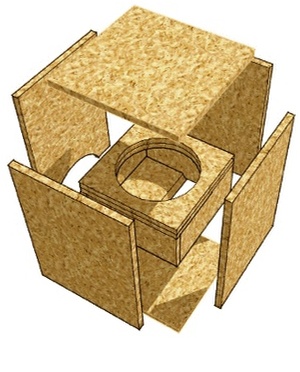
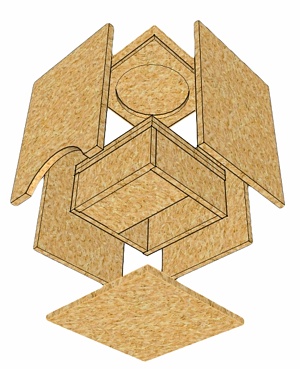 DBK-10 Exploded
View
DBK-10 Exploded
View
Post your Deathbox videos
on YouTube!
GET THE PLANS NOW FOR $19.95
 instant download
|