|
ROOM TREATMENTS - WHERE DO I START? SEPT 2002 Dimensionally there are good rooms and there are bad rooms. Few rooms are dimensionally perfect unless built or modified to comply with the following formulas: If your room doesn't come close to one of these three ideal formulas, welcome to the real world. I need to stop right here and mention that IF it is possible to move a wall or change a ceiling height so that your room hits one of these formulas, do it. Many rooms can be made smaller to hit one of these formulas. There are two forms of room treatments. A) absorption and B) diffusion. You will need the correct balance of both to treat any room. Assuming you have hi-end gear you will know if you need room treatment by how long it takes you to get tired of listening to it. If you get tired of listening at all, you probably need room treatments. Two things are effected by the acoustics of any room. A) frequency balance and B) sound stage resolution. It is important to work on A) frequency balance, FIRST. It is common for any room to create holes and peaks in the frequency balance for any given place in the room. The most easy to notice area is low frequency response. Since low frequencies are larger more evenly spaced wave fronts they tend to wash the room evenly and fold back on themselves evenly. When the waves fold back on themselves after hitting the walls, they usually cancel each other out. This phenomenon creates a zone though the center of the room with high cancellation, or no bass. In the corners of the room and along the walls the bass seems considerably stronger because there is less cancellation. High frequencies are smaller wave fronts packed close together and they do not wash the room evenly. In fact, they radiate from your speaker like beams of light that bounce all over your room endlessly. Every time their paths cross, the angle of incident and timing determines one of two results. A) Cancellation or B) Addition. In other words, standing in one spot a 2 kHz tone may be 75dB, move 6 inches to another spot it may be 85 dB and in another spot be only 65 dB. If you could see sound, the combination of A and B would make your room look like a block of Swiss cheese. The Sound stage resolution or imaging quality of a system is effected by wall, floor and ceiling reflections the hit your front wall behind the speakers and then pass back by your ear a second time. Your brain can't tell the direct from the reflected energy because they are too close together in both time and volume. To correct this problem these reflections must be BOTH delayed in time, and lowered in volume. Once done, your brain will interpret the reflections as ambience and the result will be a crystal clear perfectly focused sound stage. To correct frequency balance problems you typically use ABSORPTION. To correct sound stage resolution you typically use DIFFUSION. Absorption means simply absorbing sound across a specific band of frequencies. Diffusion means simply diffusing sound energy into a wider pattern with less energy.
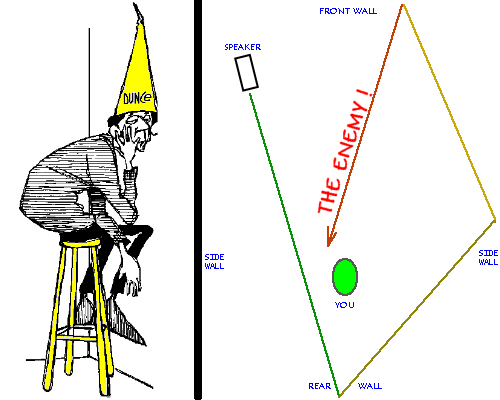
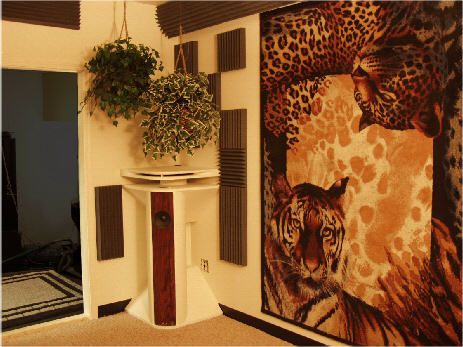
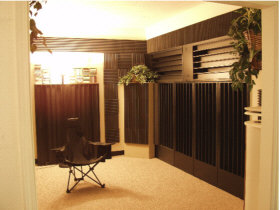
THE PLACE TO START in any room is a simple test of where your at. How good, or how bad IS the room. I always focus on frequency balance first. Walk around in your room and clap your hand once from different locations. Listen to the sound - in particular, the decay. The hand clap should sound dry and tight. You should hear the sound come from everywhere at the same time. The sound should stop almost immediately after each clap. If you hear the sound come from your hands and nothing from the room, the room is too dead. If you hear the sound come from the room as being louder then the sound from your hands the room is too live. 50 milliseconds is considered a good decay. In a hard room it's not uncommon for the decay to last over 1 second. When this happens, there is a ringing associated with each clap. You can repeat this test over as you add treatment to your room. Assuming your room needs some treatment (most do) The most obvious place to start is with the bass. When bass is properly treated two things happen. A) it tightens up and becomes articulate and B) reduces the difference between the hole in the middle of the room with no bass and the area around the perimeter of the room where there is usually too much bass. The most common surprise once someone has corrected the bass response is how much bass effects the midrange and overall focus of the sound stage. The common 60 to 80 cycle region that is typically way too loud in most moderate size rooms is called "room boom". Room boom is bad. Bass traps are the most common way to correct low frequency issues. The problem is, many bass traps only work across a narrow band of frequencies, most of them too high to correct the whole problem. Bass traps to be effective always end up being large. It's easy when your building a room to incorporate bass traps into the structure in a way that can not be seen. In finished rooms you have limited options. The best product I've seen so far that works for everyone is the CWAL unit by Acoustic Control Co. It is a large corner unit that absorbs across a wide band of frequencies and is always noticeable. Tube traps are less effective but easier to purchase since you don't have to build them yourself. A separate paper would be required to deal with all the different types of traps and how to use them best so I won't cover it here. If you're not a handyman, the best thing is to buy what you can find, and settle for something is better than nothing. The next thing you should do is deal with midrange and high frequencies. Absorbing these is far easier than absorbing bass frequencies. A sponge on the wall can absorb a wavelength equal to around 4 times it's thickness. That means a 2 inch thick sponge can easily handle high frequencies, but it would take a sponge about 15 feet thick to handle low bass notes. That's why bass traps were invented, an attempt to reduce the size needed to get the job done through more efficient means of absorption. The ringing associated with the hand clap starts at around 2 kHz and can easily be treated with thick rugs, 2 inch foam, or heavy draperies. Carpet, and the type of padding under it will have more effect on the decay of your room than anything you will put on the walls. Unless of course you plan to create layered absorbers for your walls, by placing an air space or padding behind thick materials. Your room should be a combination of reflective and absorptive surfaces. For example, a soft floor (carpet with padding) and a hard ceiling. An ideal to shoot for is NO TWO PARALLEL SURFACES should be the same. If an area of one wall is treated with absorption, the opposing surface should be reflective. It is possible to make two whole walls soft, and leave two walls hard and get a fair result. A better result comes from mixing it up a bit more than that. Diffusers can be considered to replace the reflective surfaces of your room and should be especially if your room is small. The smaller your room the more important diffusers become. The illustration above deals with diffusion. It shows how the reflected sound always finds its way back to the front wall. From the point where that reflection leaves the front wall on is the enemy. Having a hard reflective surface on this wall ensures that you will never experience a high resolution sound stage or genuine sound stage depth. This is where the big screen TV dilemma comes in. This is why we always suggest NOT trying to blend the home theater with high quality stereo playback. If you diffuse the sound that reflects off the front wall you will have depth in your sound stage that appears to go right through the wall. Once you have diffusers placed on your front wall, some carefully placed diffusers on each side wall will enhance the performance of those already placed on the front wall. In addition they will allow your sound stage width to expand in the same manor as the depth did when you treated the front wall. Adding diffusers to the rear wall will enhance the performance of any other diffusers you have in your room. An ideal that is not too realistic would be to replace every flat surface in the room with some sort of diffusion. If you listen to a system without diffusion vs. one with diffusion you will notice something else begins to happen that is closely related to frequency balance. In the untreated room the louder you play the stereo, the worse it typically sounds. This is the point where the room takes over. In a treated (diffused) room this point where the room overcomes the system is pushed to a point beyond your worries. In fact it almost seems the louder you play it, the better and bigger it sounds. In conclusion, you need to create absorptive surfaces with either foam panels or wall rugs in places around your room so that you eliminate as many parallel surfaces of the same hardness as possible. You need to install some sort of bass traps in the corners to absorb the room boom. You need to install diffusers in the correct locations to enhance the focus and size of your sound stage. Doing so will add consistency to the sound of your system. You will have less moments where it sounds bad, less distractions to keep you from the music. Only under these conditions is your system capable of fully showing you the differences between one type of cable or another.
Decware is a trademark of High Fidelity
Engineering Co. |